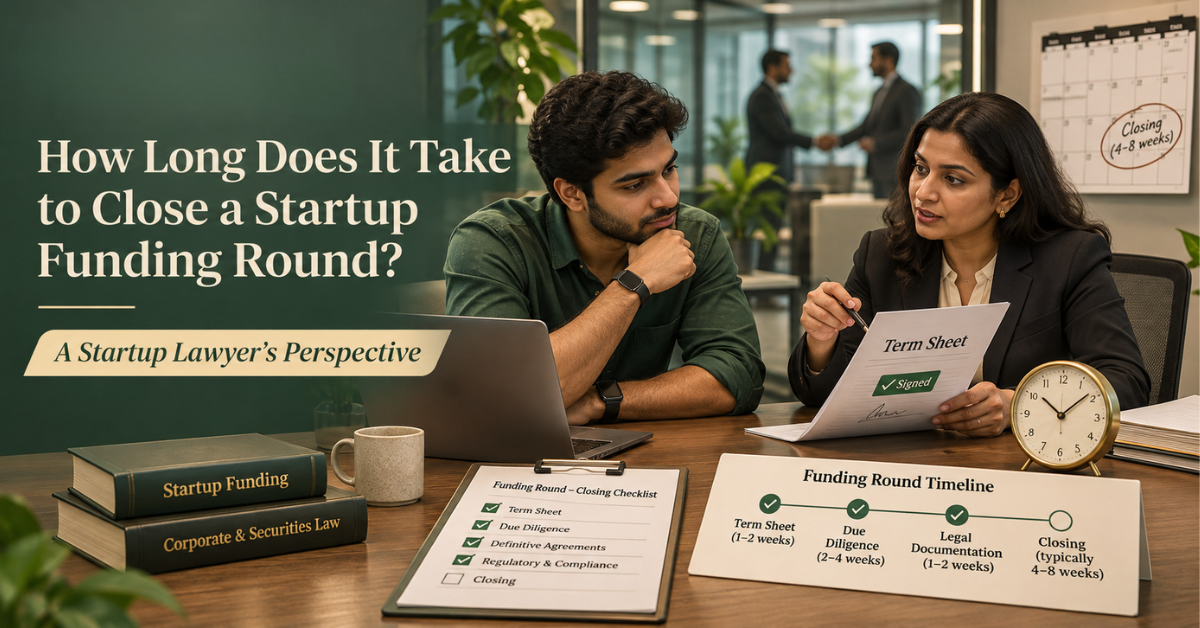
The investor approves. You have a signed term sheet, and you have a plan for the money. When does the cash actually land in your bank account? The vast majority of founders guess two or three weeks. The truth is usually longer, and many teams are caught unaware by the gap. In India, only after legal due diligence, negotiation of agreements, corporate approvals, and a clutch of filings with tight deadlines is a funding round for a startup completed. In this guide, we walk through each phase from term sheet to allotment, the legal clocks that start, the reasons deals stall, and the things that do shorten the timeline. Let’s take it apart.
Quick answer: Once a term sheet is signed, the legal work to close a round in India generally takes 4 to 12 weeks. It’s harder to find seed rounds with clean records. Once money is received, the company must:
- Allot shares within 60 days.
- File Form PAS-3 within 15 days after allotment.
- File Form FC-GPR within 30 days (in the case of foreign investors).
What “Closing” Means in a Startup Funding Round
Signing and closing are different moments. Signing: The signing of the Share Subscription Agreement (SSA) and the Shareholders’ Agreement (SHA) takes place when the company, the founders, and the investors sign. The investor pays up, and the company allocates shares later. That’s closing.
Between them is a list of conditions precedent. These are tasks that the company must complete before the investor releases money. They commonly are:
- Adoption of resolutions by the Board and shareholders
- Obtaining a report from a registered valuer
- Filling gaps discovered in due diligence
- Adoption of SHA reflected in amended Articles of Association
- Waivers from existing shareholders
And that’s why this matters. When an investor says, “We will close in two weeks,” they generally mean signing. The money is the last thing that happens. All conditions are met.
A Realistic Timeline, Phase by Phase
All startup funding rounds follow the same phases, but at different rates. Use this table for planning purposes only, not as a guarantee.
| Phase | Rough duration | What happens | Who controls the clock? |
|---|---|---|---|
| Term sheet negotiation | 1 to 3 weeks | Valuation, instrument, investor rights and exclusivity agreed | Founders and lead investor |
| Legal due diligence | 2 to 4 weeks | Investor’s lawyers review records, contracts, IP and filings. | Mostly the company’s readiness |
| Drafting SSA and SHA | 2 to 4 weeks (runs alongside diligence) | Long-form agreements drafted and negotiated | Both sets of lawyers |
| Conditions precedent | 1 to 3 weeks | Approvals, valuation, clean-up items, waivers | The company |
| Funding and allotment | A few days to 2 weeks | Money received, board allots shares | The investor’s bank and the board |
| Post-closing filings | Up to 30 days after allotment | PAS-3, FC-GPR, share certificates | The company |
The Startup Gig’s fundraising advisory for founders says a typical engagement is 4 to 12 weeks. Add the overlapping phases, and that range is what the table gives you.
How Round Size Changes the Timeline
And once you’ve got the paperwork in hand, a small angel round with two or three investors can close in less than a month. But a priced seed round led by a fund takes longer because the fund does fuller diligence and has to get internal committee approval. Series A and on rounds come with more investors, more negotiated rights, and more existing shareholders you need consent from.
The Legal Clocks You Cannot Ignore
Once money starts moving, there are fixed deadlines in Indian companies and foreign exchange law. Miss them, and you can be charged refunds, interest, or late fees. Most priced rounds are private placements, and these rules apply:
- First, shareholder approval. According to Rule 14 of the Companies (Prospectus and Allotment of Securities) Rules, 2014, a company requires special resolution of its shareholders before it makes a private placement offer.
- Separate bank account. Section 42 of the Companies Act, 2013, requires that application money be kept in a separate bank account till allotment.
- Allocate within 60 days. The same section also states that the company has to allot shares within 60 days of receiving the money. If it cannot, it must refund within the next 15 days or pay 12 per cent interest per annum.
- No spending until PAS-3. The money cannot be used by the company until shares are allotted and the return of allotment is filed. Rule 14 stipulates the filing of Form PAS-3 within 15 days from allotment.
- Foreign investors add another step. Form FC-GPR is to be filed within 30 days from the date of issue to a non-resident, as per the list of returns submitted to RBI.
The price is important for foreign money too. According to the RBI Master Direction on Foreign Investment in India, shares issued to non-residents by an unlisted company cannot be priced below a fair value worked out on an arm’s length basis. If the round is a mix of resident and foreign money, build your valuation report around the two investor types.
Why Deals Stall: What Slows a Round Down
Based on our experience advising founders, delays are rarely about the investor changing their mind. They are from papers that should have been filled out months ago. The usual suspects:
- Old holes in compliance. Missed ROC filings, unfiled share transfers, or past allotments without PAS-3 can push back closing by weeks.
- IP that the company doesn’t own. If the code was developed by a freelancer or founder before incorporation, then a signed assignment deed is needed.
- Verbal ESOP Commitments. Investors want to see all the options in a board-approved ESOP plan and the cap table as promised.
- Existing Shareholder Approval. Earlier investors may have pre-emptive or consent rights, and it takes time to chase signatures.
- Glitches in foreign remittances. FEMA paperwork held up by KYC checks, bank queries, missing inward remittance certificates.
- Over-negotiating trivial points. Founders sometimes spend a week on clauses that don’t matter later on.
Most of these problems will be revealed during a full legal due diligence review before you start pitching, while you still have time to fix them.
How to Close a Funding Round Faster
You don’t control the investor committee’s calendar. You can control most everything else. Next steps to close sooner:
- Do your own due diligence first. Fix the filings, the assignments, and the contracts before the investor’s lawyers find the holes.
- Build the data room early. Organise incorporation papers, cap table, financials, tax filings, key contracts and IP records in a shared folder.
- Set a timetable for closure in the term sheet. Set up target dates for diligence, signing and closing.
- Get approvals in queue early. Book board meetings and organise shareholder meetings, including shorter-notice consents where permitted by law.
- Prepare FEMA paperwork in advance. For foreign investors, have the valuation certificate and bank documents ready and keep the FIRMS portal access of your company active. Specialist FEMA and RBI compliance support to enable you to meet the 30-day reporting window.
- Choose your fights. Focus negotiation time on valuation, control rights, and liquidation preference, not on boilerplate.
Don't Let Hidden Compliance Gaps Kill Your Funding Round
Book a Pre-Funding AuditQuick Recap
- Signing and closing are separate events. Money comes only after conditions precedent are met.
- In most Indian deals, legal work from the term sheet to closing takes 4-12 weeks.
- Allot shares within 60 days of receipt of money, file PAS-3 within 15 days, and FC-GPR within 30 days.
- Delays are usually due to old compliance gaps, not investors.
- Self-diligence and a written plan for closing the process.
Final Thoughts
A startup funding round closes on paper long before it closes in your bank accounts. The fastest founders to close treat the legal work as part of the raise and not something they do after. Timelines matter; clean records and early approvals can save weeks in the process and keep your runway safe. If you have a term sheet on the table or expect one soon, the Startup Gig legal team can review your documents and map out a closing plan that works for your round.
Disclaimer: This article is for general information purposes only and does not constitute legal, tax, or financial advice. Rules and deadlines may change, so please seek advice from a qualified lawyer, company secretary, or chartered accountant before acting on your funding round.
Got a Term Sheet? Let’s Close the Round Faster
Speak to a Fundraising ExpertFrequently Asked Questions
Is a term sheet legally binding in India?
Mostly not. The commercial terms are typically non-binding in a term sheet. In most cases, the clauses on confidentiality, exclusivity, costs, and governing law are binding, so read them carefully before you sign, because they apply even if the deal never closes.
How long does exclusivity in a term sheet usually last?
Exclusivity is typically 30-60 days. You can’t negotiate with other investors at this time. Keep it as short as your schedule allows and ask that it end automatically if the investor walks away early.
Do convertible notes or iSAFE notes close faster than priced rounds?
Yeah, often. Convertible instruments defer the discussion of valuation and have a shorter document, and thus there are fewer points to negotiate. The legal steps are reduced but not eliminated, as they still need board approval, proper paperwork, and, for foreign investors, FEMA reporting.
What happens if the investor does not pay after signing?
Most SSAs will include a long-stop date. The normal rule is that if settlement has not occurred by then, either party may terminate the agreement. Founders should keep talking to backup investors until the money’s in the company’s bank account.
Who pays the legal fees in a startup funding round?
In many Indian rounds, the company pays its own lawyers and also reimburses the legal costs of the lead investor up to an agreed cap. Negotiate that cap in the term sheet, so you’re not surprised by legal costs at closing.