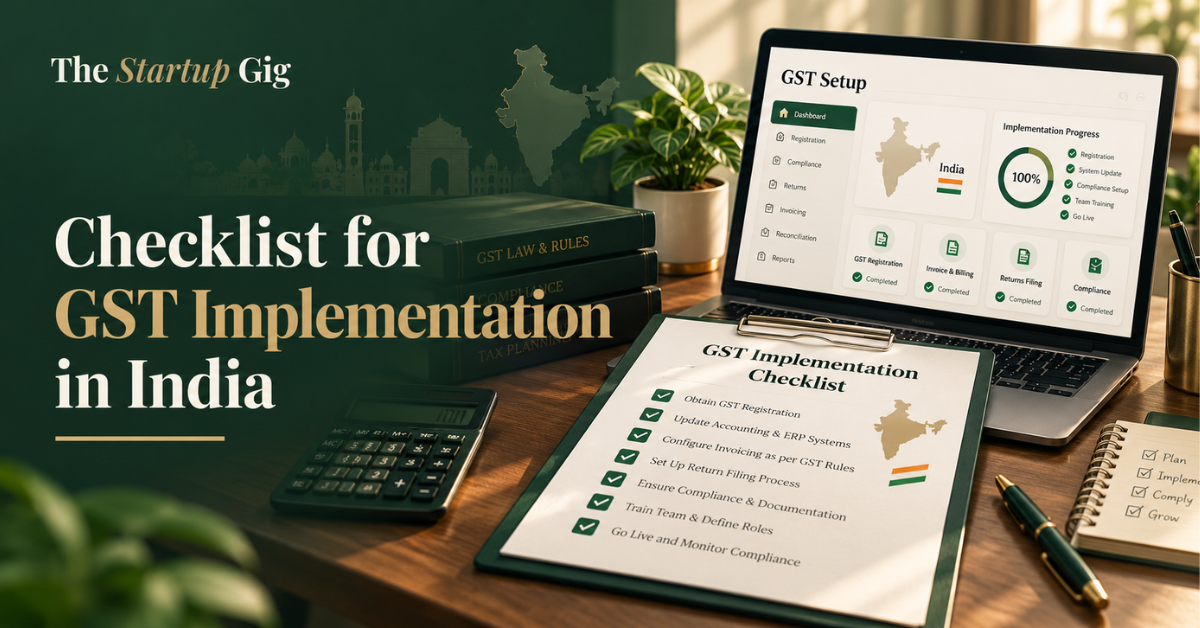
GST has been live since 2017. KPMG’s tax flash on the 56th Council meeting describes the introduction in 2017 as a landmark reform. So when we talk about GST implementation in India for 2027, we are talking about something more practical: how a business sets up GST properly and stays up to date with the latest changes.
Timing is everything. The 57th GST Council meeting was held on 8 October 2026, and several proposals point to April 2027. So, I’m going to turn that into a simple step-by-step checklist for you to follow.
Table of Contents
Quick Answer: What Does GST Implementation in India Mean for a Business?
In GST implementation, a business has five jobs to do: find out whether you need to register or not, register on the GST portal, set up correct invoicing and rates, file returns on time, and manage your input tax credit (ITC). You then work through the rules before every financial year.
Here’s the short version:
- 1. Review registration rules
- 2. Select your return plan
- 3. Register and safeguard your account
- 4. Rates and product map
- 5. Make an invoice
- 6. Create a calendar of returns
- 7. Reconcile ITC monthly
- 8. Check changes before April 2027
What Is New for 2027? Recommendations vs. Law
A word of warning. The India Briefing report of the meeting of 8 October 2026 shows that the results are recommendations for amendments, notifications and circulars and should not be taken as implemented legal changes until the legal instrument and effective date are verified.
But the direction is evident. Here are the most relevant proposals for a business setting up GST:
- Registration: The Council recommended acceptance of amendments to most registration details automatically, except for the principal place of business, which could be updated automatically by the taxpayers under Rule 14A.
- Returns and ITC: It proposed introducing the mechanism for correction of tax liabilities and ITC reporting from the April 2027 return period, with consultation before finalising the changes.
- E-invoicing: E-invoicing would be extended to cover reverse-charge purchases from unregistered suppliers and imports of services for taxpayers with aggregate turnover of ₹5 crore or above.
- Refunds: A provisional payment of 90 per cent of the amount claimed will be made through an automated, risk-based process for zero-rated and inverted duty claims that meet the criteria.
- Late fees: The Council recommended waiving late fees for certain delayed returns of taxpayers with a turnover of up to ₹5 crore in the previous year, if filed by the end of the month in which they were due.
Rates changed a year ago also. The 56th Council adopted a two-rate structure for India with a standard rate of 18% and a merit rate of 5%, with a special 40% rate for a handful of goods and services, starting 22 September 2025 for most items.
The GST Implementation Checklist
Work through these ten steps in order.
Step 1: Check Whether You Must Register
Most cases are decided by turnover limits. ICAI training material prescribes a limit of 40 lakh for persons supplying goods only. Special category states and services have lower limits. Please verify the limit that applies to your state.
No matter what their turnover, some companies must register. Under the CGST Act, section 24 has relaxed the normal limits for the notified categories like interstate suppliers and the e-commerce operators. If you sell to another state or sell through an e-commerce platform that collects tax, check this rule first.
Step 2: Choose Your Return Scheme
Small taxpayers could be able to file less often. The West Bengal tax circular said a registered person with an aggregate turnover of up to ₹5 crore in the preceding year can opt for the QRMP scheme, which allows quarterly returns with monthly tax payment. The option is available in the GST portal under Services > Returns > Opt-in for Quarterly Return. There is another option for smaller taxpayers, within limits, so ask your adviser which is best for your business.
Step 3: Gather Documents and Register
Registration on the GST portal is divided into two parts. Part A is where you will input your PAN (which is mandatory), and Part B is for gathering business details. The portal’s own tutorial warns that data associated with a temporary reference number is deleted if you don’t submit within 15 days.
Timing is also a factor. If you apply within 30 days of becoming liable, your registration is effective from the date of your liability. Speed too has improved. Eligible applicants who do not want to pass on more than ₹2.5 lakh of ITC a month can get automatic registration without any involvement of a tax officer as per Rule 14A.
Step 4: Secure the Account and Add Bank Details
Treat portal access as you would banking access. Taxpayers will be required to use two-factor authentication. Please add your bank details as soon as possible too. System-based cancellation for non-filing of returns or furnishing bank account details within the prescribed time – Council recommended.
Step 5: Map Products and Rates
Create a master list of all the products and services you sell. Give each an HSN or SAC code and its current rate: 5%, 18% or the special 40% where it applies. Exempt items are at zero. Update the billing software immediately after any rate change so old rates aren’t added to new invoices.
Step 6: Set Up Invoicing and E-Invoicing
Create a GST-compliant invoice template and then check if e-invoicing is applicable. Businesses with aggregate annual turnover exceeding ₹5 crore in any financial year from 2017-18 onwards are required to do e-invoicing. Count previous years too. Once you’ve passed the limit, you’re in the rule.
If your turnover is ₹10 crore and above, watch the clock. At that level, invoices older than 30 days will be rejected by the portal. This rule kicks in from 1 April 2025. If you are carrying goods, generate an e-way bill also.
Step 7: Build a Return Calendar
Determine who files which return and when. At a minimum, plan for GSTR-1 (your outward supplies) and GSTR-3B (your summary return and tax payment) monthly or quarterly depending on your scheme. Add the annual return and create reminders a week before each due date. Give the final sign-off to one named person.
Step 8: Put ITC Controls in Place
According to India Briefing, the ITC claimed in GSTR-3B may not be the same as the credit available in GSTR-2B. Such mismatches could trigger alerts from the system, notices, or demand for tax. Claim after you have reconciled each month.
Watch your suppliers too. As per Section 16(2)(c), ITC can be claimed only if the tax charged on the supply has been actually paid to the Government. Late filers can jeopardise your credit. Before making large purchases, look into your supplier’s filing record.
Step 9: Prepare Records, Refunds, and Notices
Maintain invoices, e-way bills and reconciliations in a single, well-organised folder per period. If you export, or are in an inverted duty structure, track refund claims separately. Create a simple notice log with a due date and a named owner for each response. The Council has also suggested a minimum tax threshold of ₹10,000 for notices of show-cause under certain provisions. But until it becomes an act, answer each notice.
Step 10: Review Before April 2027
Set up a review in January or February 2027. See which council recommendations are now notifications, update your software, and update your team. Consider everything marked “proposed” as a plan, not a rule.
Ready to Simplify GST Implementation for Your Business?
Explore GST & Tax Compliance ServicesTimeline: What to Do Now vs. April 2027
| When | Action |
|---|---|
| Now to December 2026 | Confirm registration status, tidy HSN and rate master data, and test your reconciliation routine. |
| January to March 2027 | Watch for notifications and circulars, update billing and ERP software, and train your team. |
| From April 2027 return periods (proposed) | Prepare for the liability and ITC correction mechanism and any e-invoicing extension once notified. |
Common Mistakes to Avoid
- Registering late and losing the benefit of the effective date.
- Ignoring the compulsory registration categories as turnover seems small.
- Treating recommendations as law or ignoring them altogether.
- ITC claim without verification of GSTR-2B.
- Ignoring previous turnover in testing the e-invoicing limit.
- A single person is doing the filing, the reconciliation, and the approval with no backup.
Special Notes for Startups and Foreign Businesses
Usually, new companies register for GST soon after they are incorporated. Foreign companies setting up in India need an entity setup, tax, and GST in one plan. The Startup Gig’s homepage lists entity incorporation and setup, tax, legal and accounting advisory, and ongoing compliance support under its India market entry services, along with GST and TDS compliance under its Virtual CFO and Tax vertical. The order is important here because the company, bank account, and registration details all need to be the same.
Contracts are worth a look too. The customer and vendor agreements should specify whether prices include GST, the issuer of the tax invoice, and the consequences of a defaulting supplier blocking your credit. The Startup Gig discusses vendor and service agreement work on liability caps, indemnification and termination rights, and reviews counterparty drafts for bad terms. A lawyer can tell you what GST clauses to use for your deal.
Need Help Implementing GST Compliance in Your Business?
Talk to Our TeamWrapping Up
A good GST setup is a habit, not a one-time task. Check the registration rules, pick the right scheme, secure your access to the portal, map your rates, invoice correctly, reconcile ITC every month, and review before every April. If you want deal-side context on the intersection of tax and contracts, the Deal Diaries and blog on The Startup Gig’s website are worth a read. This article is for general information and not tax or legal advice, so ask for advice regarding your specific situation.
FAQs
Do I need GST registration in 2027?
It is required if your turnover is above the limit for your state and type of supply, or if a compulsory category applies (for example, the supply of goods interstate or selling through certain e-commerce platforms). Check with a tax professional about your state’s limit.
Are the 57th GST Council changes already in force?
Not by default. The reports characterise the 8 October 2026 results as recommendations that require amendments, notifications or circulars. Some proposals call for return periods of April 2027. Verify each change with the official notification and its effective date.
What are the current GST rates?
From 22 September 2025, most goods and services will be taxed at the standard rate of 18% or the merit rate of 5%. A few items will be taxed at a special rate of 40%. Exempt items stay at 0. Check your notification for your product.
Is e-invoicing mandatory for startups?
Aggregate annual turnover exceeding ₹5 crore in any year since 2017-18. Today, the vast majority of early-stage startups are below that line. The 57th meeting proposed extending e-invoicing to some reverse-charge purchases for businesses at or above that threshold.
How long does GST registration take?
That depends. The 56th Council meeting stated that automatic registration of eligible low-risk applicants under Rule 14A may be achieved in about three days. Other applications require officer review, so be prepared to wait and have your documents ready.