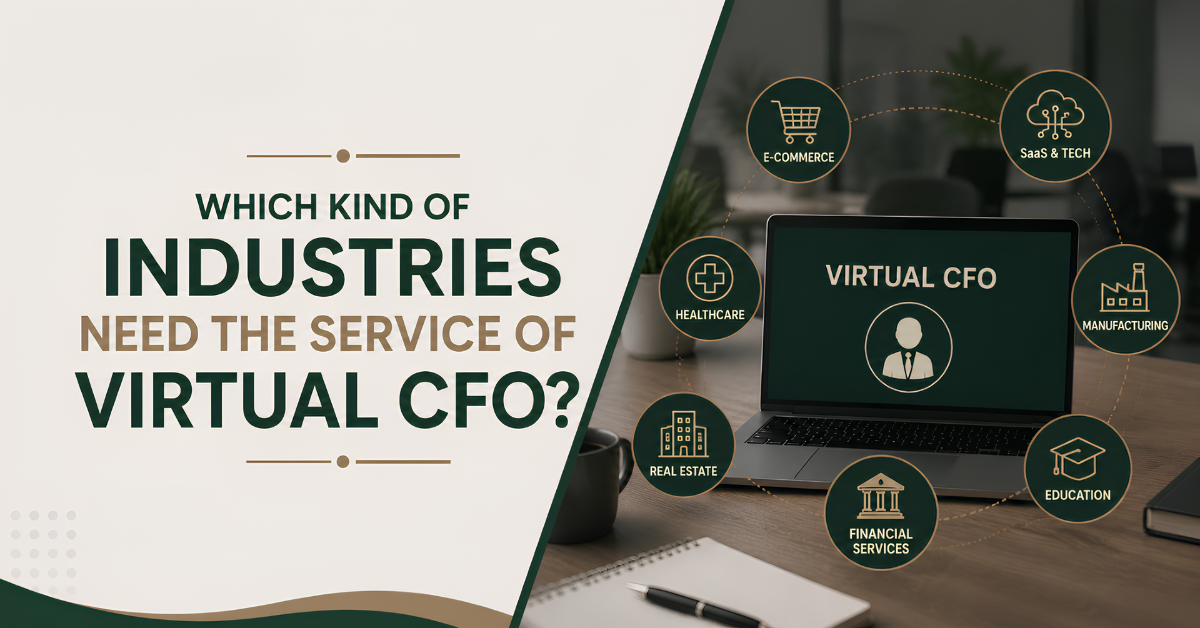
Not all businesses run into the wall of financial complexity at the same time. You can run a small services agency with three clients on a spreadsheet for years. A D2C brand selling on five marketplaces can’t, not without losing sight of what it actually earns after every platform fee, TCS deduction, and return. In India, few industries reach financial complexity faster than others, and that is where industries need virtual CFO support the most.
In this post, we look at which industries are most likely to benefit first from virtual CFO services and what makes each industry’s financial situation more challenging to handle with a simple internal setup.
Table of Contents
Why Industry Matters for Financial Complexity
For example, a virtual CFO at a SaaS startup will have a very different set of problems to deal with than a virtual CFO at a manufacturing company. One is driven by inventory financing, working capital cycles, and vendor payment terms. The other is driven by recurring revenue metrics, cross-border billing, and burn rate. That’s why it’s important to consider sector experience when choosing a provider and why some industries will need virtual CFO support sooner in their growth trajectory than others.
Don't Let Your Industry's Financial Complexity Slow Your Growth.
Get Expert Support Today1. E-Commerce and D2C Brands
The compliance burden for e-commerce companies in India is a surprise to many founders. Under Section 52 of the CGST Act, e-commerce operators are required to collect Tax Collected at Source on net taxable supplies effected through the platform. Marketplace sellers are also subject to deduction of TDS under Section 194-O of the Income Tax Act on payments credited to their accounts. When reconciling these deductions against actual settlement amounts from platforms like Amazon or Flipkart and GST filings across multiple states, if inventory sits in different warehouses, it gets complex fast. A virtual CFO cares about the real margin after all these deductions, not just the number on the invoice.
2. SaaS and Technology Startups
SaaS companies operate on metrics that don’t translate neatly to a standard profit and loss statement: monthly recurring revenue, customer acquisition cost, churn, and unit economics. Founders in this space often need financial modelling that reflects subscription-based revenue recognition, not just a simple sales ledger. SaaS companies tend to have foreign customers as well, and so does FEMA reporting for export receipts, which is a whole other level that a typical bookkeeper might not be good at managing.
3. Manufacturing and Industrial Businesses
Manufacturing businesses deal with long working capital cycles, raw material financing, and inventory valuation, none of which show up in a services business. Getting the cost of goods sold calculation wrong, or misjudging how much working capital a growth phase actually requires, can create a cash crunch even when the order book looks strong. A virtual CFO with manufacturing experience tracks these cycles closely and flags cash gaps before they turn into a payment default with a vendor.
4. Healthcare and Pharma Ventures
In India, healthcare and pharma businesses typically have long timelines for regulatory approvals and also have high upfront costs for things like clinical trials, manufacturing licences, and import duties on equipment. The financial planning here must factor in deferred revenue against ongoing compliance and licensing expenses. That is a very different rhythm than a typical consumer business. In this space, virtual CFO support services often include careful cash runway planning against these longer timelines.
5. Fintech and Financial Services Startups
According to the particular business model, be it lending, payments, or wealth management, the fintech companies are under the watchful eyes of the RBI and sometimes SEBI. Financial reporting here has to satisfy both investors and regulators simultaneously, and errors in compliance reporting can lead to regulatory action rather than just internal correction. A virtual CFO with fintech knowledge is aware of these two reporting obligations and builds the financial processes to accommodate them from the beginning.
6. Real Estate and Construction
Real estate businesses are not just about a sale. They work with project-based accounting, RERA compliance, and revenue recognition tied to construction milestones. A mistake here can affect regulatory filings and lenders’ perception of the business in terms of financing. Here, the support for a virtual CFO is generally project-driven, tracking costs and planning cash flows for many overlapping projects.
7. Professional Services and Agencies
Agencies and consulting firms seem financially straightforward on the surface because they have no inventory or manufacturing. But many run into trouble with irregular cash flow, as large projects are billed in milestones and payments often lag well behind delivery. A virtual CFO can help smooth this out with better invoicing discipline, receivables tracking, and realistic cash flow forecasting between project payments.
8. Export-Oriented and Cross-Border Businesses
Any business that takes payments from outside India, be it an IT services firm, a SaaS company, or an export-focused manufacturer, needs to take care of FEMA reporting, foreign inward remittance documentation, and often transfer pricing if there are related entities abroad. Get it wrong, and you are opening yourself up to a regulatory risk that is far more serious than a simple accounting error. Cross-border virtual CFO services experience helps keep this compliance layer running alongside day-to-day financial management.
Ready for a Finance Setup Built Specifically for Your Industry’s Nuances?
Book a Confidential CallCommon Thread Across These Industries
Despite the differences, there are a few traits common to businesses that need virtual CFO support the earliest.
- Revenue or costs related to complex, multi-step transactions, as opposed to simple sales.
- Regulatory reporting beyond normal tax filing, for example, FEMA, RERA, or sector-specific compliance.
- Cash flow patterns that cannot easily be inferred from a simple monthly summary.
- A future round of fundraising in which investors will want to see financial models appropriate to the sector.
How The Startup Gig Supports Different Industries
The Startup Gig works with founders across sectors like SaaS, D2C, manufacturing, fintech, etc., and provides virtual CFO services covering accounting, GST & TDS compliance, payroll, financial modelling, valuation, and MCA filings as one coordinated function. Because the team works across legal, secretarial, and financial advisory together, sector-specific issues, such as FEMA reporting for a cross-border SaaS company or GST reconciliation for a multi-state e-commerce seller, are handled by people who already understand the rest of the company’s structure.
Final Thoughts
Virtual CFO services are not restricted to any one type of business, but some industries tend to need top virtual CFO support for startups sooner and more heavily, simply because their financial and regulatory picture becomes complicated more quickly. Regarding your business, if you have multi-step transactions, cross-border payments, or compliance issues that go beyond standard tax filing, that complexity is often the most obvious indicator that it’s time to bring in financial support dedicated to your business.
Frequently Asked Questions
1. Do small businesses in simple sectors need virtual CFO services?
Not always straight away. For a small services business that has simple billing, basic bookkeeping can often get you by for a while. The need is often greater with the complexity of cash flow, compliance, or fundraising.
2. Why do e-commerce businesses need virtual CFO support specifically?
E-commerce sellers have to deal with TCS under GST, TDS under Section 194-O, and reconciliation across multiple marketplaces and states. This makes tracking true margins and compliance much more complex than a standard retail business.
3. Is virtual CFO support useful for regulated industries like fintech and healthcare?
Yes, often more so. These areas require a combination of standard financial management and sector-specific regulatory reporting, where mistakes have consequences beyond accounting corrections.
4. Can a virtual CFO handle FEMA compliance for export-orientated businesses?
While many virtual CFO providers with cross-border experience do handle FEMA reporting and foreign remittance documentation, it’s worth exploring this expertise before choosing a provider.
5. How do I know if my industry needs virtual CFO support now?
If you are doing multi-step transactions, have compliance requirements outside of tax filing, or have an inconsistent cash flow that you cannot track from a monthly summary, that is generally an indication that the complexity has outgrown a basic setup.