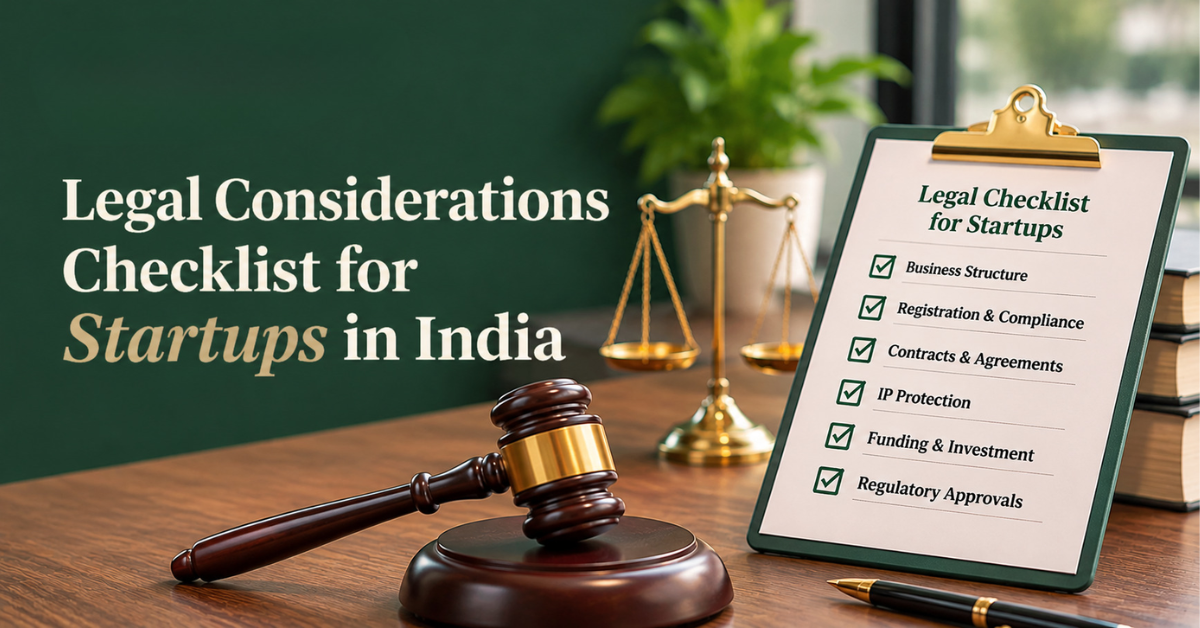
The easy part is incorporation. The legal holes that hurt startups usually appear later, when an investor’s lawyer starts asking questions or a co-founder leaves. Is your equity split in writing? Is the company its own code? Have you filed your return for each year? This legal checklist for startups covers the top 10 areas. Indian founders most often overlook post-incorporation. Each item tells you what applies, when it applies, and what to do next. Use it today to do a quick health check on your startup, and again before every funding round. Let’s break it down.
Quick response: Here are 10 legal things that every Indian startup should explore:
- Entity & DPIIT Certificate
- Founders’ agreement and vesting
- Cap table and ESOP plan
- Ownership of IP
- Contracts with customers and vendors
- Job Papers
- POSH compliance
- Protection of data
- Tax registrations and benefits
- Annual ROC filings
Table of Contents
Foundation: Entity, Founders and Ownership
1. Entity Type and DPIIT Certificate
The majority of funded startups are private limited companies because only companies can issue shares and ESOPs to investors and employees. If you are still a partnership or LLP and are planning to raise equity, plan the conversion early. Apply for a DPIIT Startup Certificate. It is optional, free, and gives access to government schemes and startup tax benefits.
2. Founders’ Agreement and Vesting
A founders’ agreement outlines the equity split, roles, decision rights, and what happens if someone leaves. The most helpful clause is vesting. A vesting schedule means each founder earns their shares over time, typically with a one-year cliff. If a co-founder leaves in the early days, unvested shares go back to the company, not to someone who no longer works there.
3. Cap Table and ESOP Plan
Investors will look at your cap table before anything else, almost always. It must list all shares, convertible instruments, and option promises and match your ROC filings.
ESOPs require a board-approved plan and a special shareholder resolution. The 2019 release from the Ministry of Corporate Affairs had extended the window for DPIIT-registered startups to give ESOPs to promoters or directors holding more than 10% of equity from 5 years to 10 years from incorporation. The Startup Gig’s ESOP advisory for startups encompasses drafting, valuation, and approvals for a planned structure.
Protecting What You Build
4. IP Ownership
Only if your code, designs, and brand are legally owned by the company are they company assets. Check three things:
- All founders have signed an IP assignment for work done pre- and post-incorporation.
- Freelancers and agencies sign contracts assigning IP to the company.
- Your trademark application is filed in the name of the company or is assigned to the company.
5. Customer and Vendor Contracts
Scope, payment, liability caps, termination, and dispute resolution should be covered in standard customer terms. Vendor contracts should include clear scope, timelines, and data handling clauses. If you sell online, you’ll need terms of use, a refund policy, and a privacy policy for your website that are in line with how your product actually works.
People and Workplace Compliance
6. Employment Documents and the Labour Codes
Everyone you employ should have an offer letter/contract of employment, detailing role, pay, confidentiality, notice and IP ownership. The 4 Labour Codes came into effect on 21 November, 2025, replacing 29 older central labour laws. Review your HR policies, leave rules, and salary structures vis-à-vis the new codes. As the team grows, a written employee handbook and HR policies keep these rules consistent.
7. POSH Compliance
This is one that many startups miss. Every workplace having 10 or more employees is required to constitute an Internal Committee under Section 4 of the Sexual Harassment of Women at Workplace (Prevention, Prohibition and Redressal) Act, 2013. The committee should have one external member and one senior woman employee as presiding officer, and half of its members should be women. Under Section 26 of the Act, if the employer does not constitute the same, a fine up to ₹50,000 can be imposed. What to do when you reach 10 people:
- Develop a written POSH policy
- Establish an internal committee
- Conduct awareness sessions for the team
- File your state-mandated annual report
Data, Tax and Foreign Investment
8. Data Protection
If your product collects personal data, you are covered by the Digital Personal Data Protection Act, 2023. A PIB backgrounder on the DPDP Rules was notified on 14 November 2025 with an 18-month phased compliance period. Use this window to map what data you collect, rewrite consent notices, and establish a process for dealing with user requests and data breaches.
9. Tax Registrations and Startup Tax Benefits
Please make sure your GST, TDS, and Professional Tax registrations are in line with your activities and states. Eligible startups can also get a 100% deduction on their profits. The deduction can be claimed under Section 140 of the Income-tax Act, 2025, for any three consecutive tax years out of ten, beginning from the year of incorporation. Section 140 replaces section 80-IAC for the 2026-27 tax year, and you still need separate approval to claim it.
Add FEMA compliance to this list if you take money from foreign investors. The timelines for share pricing rules and RBI reporting forms such as FC-GPR are stringent.
Ongoing Compliance: Annual ROC Filings
10. Annual ROC Filings and Board Records
All companies have to have board meetings, keep statutory registers, and file annual returns with the Registrar of Companies irrespective of revenues. There are two main annual forms: AOC-4 for the financial statements and MGT-7 or MGT-7A for the annual return. Missed filings add additional fees for every day they’re late and could halt a funding round in due diligence. A recurring ROC compliance is planned to keep all dates in one place.
Also check the sector rules. Fintech, healthtech, edtech, and food startups may need to apply for licences or registrations with the sector regulators before they launch.
Legal Considerations Checklist for Startups at a Glance
Save this table as a one-page startup legal considerations checklist and revisit it every quarter.
| # | Item | When it applies | Risk if missed |
|---|---|---|---|
| 1 | Entity and DPIIT certificate | From day one | Fundraising blocks, lost tax benefits |
| 2 | Founders’ agreement and vesting | Before or at incorporation | Equity disputes when a founder leaves |
| 3 | Cap table and ESOP plan | Before granting any options | Diligence delays, invalid option promises |
| 4 | IP ownership | Before launch | The company does not own its product. |
| 5 | Customer and vendor contracts | From first sale | Unpaid invoices, unlimited liability |
| 6 | Employment documents | From first hire | Disputes over pay, notice or IP |
| 7 | POSH compliance | At 10 or more employees | Fines and reputational harm |
| 8 | Data protection | From first user signup | Penalties once DPDP duties apply |
| 9 | Tax registrations and benefits | From first invoice | Interest, penalties, missed deductions |
| 10 | Annual ROC filings | Every financial year | Daily additional fees, diligence, red flags |
Stop Early Legal Mistakes from Becoming Expensive Disputes
Secure Your Startup’s FoundationQuick Recap
- Document founder vesting. Maintain a current cap table that reflects ROC filings.
- Make sure all IP created by founders, staff, and freelancers is owned by the company.
- If you have 10 employees, set up a POSH Internal Committee.
- The DPDP phase-in timeframe is your chance to fix consent notices and data processes.
- Monitor all annual ROC filings and check eligibility for the Section 140 deduction.
Final Thoughts
Legal housekeeping seldom becomes urgent until an investor, employee, or regulator makes it urgent. Going over this legal considerations checklist for startups annually, and prior to each round of funding, prevents small gaps from becoming deal-breakers. Begin with the items that apply to your stage today, then add the rest as you hire, sell, and raise. Next steps: Score your startup against the ten items above, and make a list of what is missing. If you need help closing those gaps, the Startup Gig’s legal and secretarial teams work with founders on those exact areas.
Disclaimer: This article is for general informational purposes only and is not legal or tax advice. Laws, thresholds, and deadlines change. Speak to a qualified lawyer, company secretary, or chartered accountant about your startup.
Don't Let Missing Paperwork Derail Your Growth
Schedule a Legal Health CheckFrequently Asked Questions
How often should a startup run a legal audit?
Do a full legal audit every year and before each round of funding. A quick quarterly check of filings, new contracts, and new hires is also helpful, since small gaps are much cheaper to fix early than during investor due diligence.
Does a startup with fewer than 10 employees need a POSH policy?
If the number of employees is less than 10, there is no internal committee, and complaints are addressed to the local committee in the district. But a short written POSH policy is good practice, as it sets out clear expectations and prepares you for when you cross 10.
Can an LLP offer ESOPs to its team?
No, ESOPS are available only to companies under the Companies Act, 2013, as an LLP has no shares to issue. LLPs typically provide profit-sharing arrangements to reward senior team members or convert to a private limited company before offering equity.
Is the DPIIT startup certificate mandatory?
No. It’s optional. You can operate and finance a startup without it. You need it for government schemes like the Seed Fund Scheme and credit guarantees and to apply for the startup profit deduction under Section 140.
Which legal documents do investors review first?
Investors usually start with the cap table, the founders’ agreement, shareholder records, and ROC filings. Then they review the IP assignments, major customer contracts and employment agreements. A data room with clean, organised documents speeds up due diligence and builds investor confidence.